Abasi Concepts Micro-Aggressor Compressor Review
Updated: Aug 18
The Abasi Concepts Micro-Aggressor is a very different kind of compressor pedal.
It was designed with extended-range guitar in mind and is described as a boost-style compressor that adds clarity, attack and character while keeping lower frequencies under control. That immediately caught my attention as something interesting for bass players, especially those of us playing 5-string basses.
After spending a lot of time with it, I think the Micro-Aggressor is a unique pedal and it can sound excellent on bass and definitely sounds amazing on guitar.

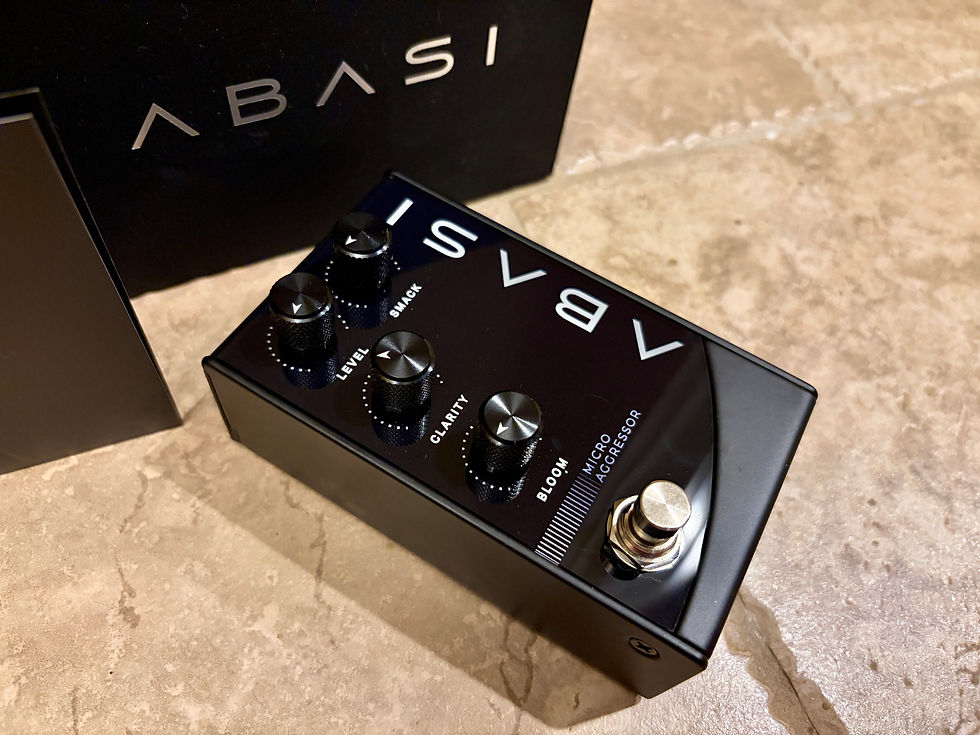
The Micro-Aggressor uses two parallel compression circuits controlled primarily by the Bloom and Smack knobs.
There are four controls:
Level controls the output level of the primary compression circuit.
Bloom controls the amount of compression in the primary circuit.
Smack controls the output of a second parallel compression circuit that is designed to keep things natural while adding more weight to the low end.
Clarity is a tilt-style EQ. Turning it clockwise adds more high-frequency content and articulation. Turning it counterclockwise makes the sound thicker and warmer.
The internal transformer gives the Micro-Aggressor some extra amp-like character and helps it feel a little more lively and dimensional.The result is something that sits somewhere between a compressor, boost pedal, and tone-enhancing preamp. I think that's probably the best way to approach the Micro-Aggressor.
If you turn it on and expect a conventional compressor with threshold, ratio, attack and release controls, this isn't it. You'll be disappointed. But if you approach it with an open mind and accept it for what makes it so unique, you might be rewarded.
How does it sound?
To start, the Micro-Aggressor is not transparent. Turn it on and you hear it. More importantly, you feel it. Notes become more immediate and seem to feel more lively. There is additional density and presence, but the initial attack remains pronounced. It does not have the flattened or overly controlled feel that some compressors can produce.
With this device its as important to talk about the feel as it is the sound (or tonal enhancement attributes). To me the Micro-Aggressor as more present and immediate than a traditional compressor. In other words, it has a lively quality to it. When you turn it on there's this inherent thing about it that sees to make an instrument feel easier to play because softer notes become more audible while harder notes retain plenty of attack.
I think you'll notice it with tapping, slap, harmonics and other techniques where individual notes can vary significantly in volume.
With that high level narrative about the the sound out of the way, let's revisit each of the controls with that in mind.
Bloom
Bloom is the control that gives the Micro-Aggressor much of its compression character.
At lower settings, it adds some density and sustain without making the compression particularly obvious. As Bloom is increased, the effect becomes considerably stronger.
It also affects the low end. This is important for bass in that increasing Bloom does make the bottom end sound bigger and more forward. With a 5-string bass, the B string can become noticeably more substantial but there is a "but be careful" thing here. There is a sweet spot where the B string sounds fuller and more controlled without becoming oversized. However, if you push Bloom farther the low end can start to distort. Players with a 5 string bass or hot output (like with an onboard preamp) will probably want to use Bloom conservatively unless you appreciate the tonal impact of audible distortion.
Smack
Smack adds a second layer of compression that helps the low end feel bigger and more solid without sounding overly compressed. On guitar or bass, I find Smack to be one of the most interesting controls on the pedal. Adding Smack makes notes feel more solid and immediate. It adds punch without producing the same obvious compression character that you get from increasing Bloom. Notes become
more defined and seem to have more authority without necessarily sounding louder than the other strings. This is true on guitar or bass guitar.
Using Bloom and Smack together lets you balance body and punch. Think of it this way: Bloom adds more of the compression character. Smack adds weight and immediacy.
Clarity
Clarity is essentially a tilt EQ centered around noon. Turn it clockwise and the Micro-Aggressor becomes brighter and more articulate. Turn it counterclockwise and the sound becomes warmer and thicker. This kind of function isn't something I typically feel is critical on a compressor for me personally. But the implementation here, and how it interacts with the Bloom and Smack controls, is quite useful. Bloom and Smack can add a considerable amount of density. That's why a little additional Clarity can bring definition back to a darker bass or help articulate the lower strings. For me personally, I only found making relatively small adjustments useful. The useful range isn't all that great in my opinion. It's the whole too much of a good thing mentality. Turning Clarity too far clockwise can make the pedal considerably brighter, especially with an active bass or an instrument that already has a lot of upper-midrange presence. Used moderately, however, it is a simple and effective way to balance the pedal.

Gain reduction meter
One of the cooler design features is the illuminated Abasi logo, which doubles as a visual gain-reduction indicator. The logo reacts as you play, giving you a visual indication of how hard the compressor is working. It isn't a traditional gain-reduction meter with individual LEDs or markings showing a specific number of decibels. Instead, the brightness of the logo responds dynamically to the amount of compression being applied. As compression is happening you'll notice the logo turning a more purple color. I like the implementation. It keeps the Micro-Aggressor looking clean while still providing some visual feedback about what the compressor is doing. It is particularly helpful when dialing in Bloom because you can see how much the circuit is reacting to your playing rather than relying entirely on your ears.
Headroom and Distortion on Bass
At the beginning of this review I said the Micro-Aggressor can sound excellent on bass. The word can in that statement is the important word. This is where things get interesting. Abasi apparently engineered the Micro-Aggressor around extended-range and downtuned guitars, and you can hear that in the way it handles the bottom end. With bass guitar the lows don't disappear. In fact, the pedal can make a good B string sound excellent because it helps create more definition, more immediacy and a sense that the note arrives faster. Tapping and faster fingerstyle passages become easier to hear. Slap notes pop more. Harmonics jump forward.
The Micro-Aggressor does exactly what its name implies. It makes the bass sound a little more aggressive without necessarily adding distortion.
At least until you push it too hard.
This is the biggest issue I encountered with the Micro-Aggressor. I tested the Abasi Micro-Aggressor compressor with several basses and found the pedal much more appealing with a passive instrument. For example, my 5 string Sadowsky would push the Abasi pretty easily into audible distortion — surprisingly actually. I am not talking about the subtle transformer coloration or additional harmonic character that appears to be intentionally designed into the pedal. I am talking about actual grit and clipping on stronger bass notes.
This is particularly noticeable with a hotter bass signal such as those with an onboard preamp (like my Sadowsky). I suppose that makes sense when you consider what the Micro-Aggressor was actually designed for. But an 8-string guitar producing very low frequencies is not necessarily delivering the same signal level as a hot active 5-string bass. The same is true for a downtuned gutar. That is an important difference. The Micro-Aggressor runs at 9 volts, and Abasi does not publish an input headroom specification. In my experience with the Micro-Aggressor, that matters.
Backing down the volume on the bass can reduce the distortion, but I would rather not have to lower the output of my instrument simply to prevent a compressor from clipping. Players using passive basses or lower-output instruments may never encounter the problem. But players using hotter active basses should absolutely be aware of it. As a bass player, this is probably the biggest limitation of the Micro-Aggressor as a bass compressor. It sounds fantastic. It is extremely good at how it handles and sound with bass frequencies. However, your mileage may vary, but you may find it to not be equally good at handling the actual bass signal levels of your instrument This brings us back to the notion that this device isn't your typical compressor. It's worth asking the question is the introduced distortion always bad? In my opnion, not necessarily.
The Micro-Aggressor doesn't seem to have been designed to be an invisible studio compressor. It's always intentionally adding character. There's added edge to the notes. The transformer, compression circuits, and substantial amount of available output give the pedal something closer to the feel of a compressor combined with a boost or preamp. A slight amount of grit can often sound good. It adds some edge and makes the instrument feel more alive, especially in a mix.
The problem is control. If you want completely clean compression, you don't necessarily want the pedal deciding when distortion becomes part of your tone. That is especially true if you are considering the Micro-Aggressor as an always-on compressor.

Noise
The Micro-Aggressor also isn't the quietest compressor I have used. Compression naturally brings up lower-level noise, and the Micro-Aggressor has enough output available that this can become more noticeable as Bloom, Smack and Level are increased. Dramatically more so actually. I've read a few owner reports online mentioning hiss or increased noise at higher settings and I certainly encountered this too. I wouldn't describe the Micro-Aggressor as excessively noisy at conservative settings though. But between the boost, compression and tonal enhancement happening inside the pedal, it isn't what I would choose if my primary goal were the lowest possible noise floor. As with the distortion issue, this becomes more noticeable when the pedal is pushed harder. Again, this isn't your typically compressor and could be considered more of an effect pedal.
Micro-Aggressor Versus a Traditional Bass Compressor
Comparing the Micro-Aggressor with something like an Empress Bass Compressor or Origin Effects Cali76 Bass Compressor (or even the Empress MKII or Cali76 FET compressor) isn't entirely fair. Those pedals are primarily designed to control dynamics. The Micro-Aggressor is doing something different. An Empress can compress your bass while leaving its basic personality relatively intact. The Cali76 adds some character, but it still behaves like a traditional studio-style compressor. The Micro-Aggressor becomes part of your tone.
• It adds attack.
• It adds low-end weight.
• It adds presence.
• It changes the feel of the instrument.
• It can add some grit.
That makes it much closer to a compressor, boost, and tone enhancer rolled into one pedal.
Depending on what you want, that can either be its biggest strength or its biggest weakness.
Usability and impact on tone
One thing I really like about the Micro-Aggressor is how easy it is to use. There are no ratio, attack, release or threshold controls. You basically adjust Bloom and Smack until your instrument feels right, use Clarity to balance the tone and set Level for the desired output.
That simplicity works. You don't need to understand compressor attack times or ratios to hear what the pedal is doing.
The downside is that you also don't have much control when something isn't behaving the way you want. There is no sidechain high-pass filter to prevent the B string from driving the compressor. There is no clean blend. There is no input gain control higher-voltage operating option for additional headroom (which is too bad). Those omissions become more significant on bass than they are on guitar for sure.
With bass guitar I found the usable range of the Bloom and Smack controls to be between all the way counterclockwise and 9:00 or so. Beyond that and you are introducing a color, maybe even a lot of color depending on your instrument. Now, that might be a good thing depending on what you are going for. Interestingly,
Construction
The Micro-Aggressor is a good-looking and well-built pedal and has a lot of weight to it. It feels substantial.

Input, output and 9 volt power connections are top mounted, which saves pedalboard space.
The pedal uses relay-based true bypass switching with a soft-touch footswitch. The Abasi logo illuminates white when the pedal is activated.
There is no battery compartment, so it requires a standard 9-volt power supply.
The controls are clearly laid out once you understand what Bloom and Smack actually do.
Abasi Concepts also backs the pedal with a five-year limited warranty. The face of the pedal attracts finger print smudges easily. It remains to be seen how it holds up because it seems like the face of the pedal would scratch easily. However, out of the box it looks killer. I love the layout and the gain reduction meter implementation is clever, albeit in no way as useful as the likes of the metering offered in devices from Becos, Empress, or the Cali76 lineup.
Conclusion
It doesn't simply control dynamics. It changes the way the instrument feels.
The Abasi Concepts Micro-Aggressor is easily one of the more interesting compressors I have used.
On bass, it can make the lows sound bigger, tighter and considerably more immediate. It is particularly good for tapping, slap, harmonics and other techniques where you want individual notes to jump forward.
Bloom and Smack provide two different types of compression that work extremely well together, and the Clarity control makes it easy to balance the additional low-end weight.
But bass players (especially 5 string bass guitars with onboard preamp) should understand that this pedal was designed for extended-range guitar, not specifically for bass. At least that's my experience with it. That distinction becomes apparent when using a hotter 5-string. With guitar, this isn't an issue.
It's 9-volt-only operation combined with the lack of published headroom specifications makes me hesitant to recommend it universally as a bass compressor unless you accept it for what it is. If you use a passive or moderate-output bass, this may never be an issue.
If you use a hot active 5-string, I would try one before buying. When it stays clean, the Micro-Aggressor sounds excellent on bass. And even when it doesn't stay completely clean, the additional grit can sometimes be part of what makes the pedal fun. With bass guitar, just don't buy it expecting a transparent, high-headroom studio compressor. At a retail price of $249 it isn't exactly cheap, but considering the build quality and the cost of pedals these days, it isn't all that bad.
It is a compressor that makes your instrument sound and feel more aggressive. For the right player, that is exactly the point. It's a lot of fun too.
If you are looking something unique, and can accept its quirks, the the Abasi Micro-Aggressor compressor should be on your shortlist. If you want a compressor that adds punch, attitude and character, the Micro-Aggressor is considerably more interesting.
Pros
• Excellent attack and immediacy
• Particularly good for tapping, slap and harmonics
• Bloom and Smack provide two useful compression characters
• Works very well with the frequencies produced by a 5-string bass
• Makes the lows sound bigger and more defined
• Useful Clarity tilt EQ
• Lots of available output
• Transformer adds character
• Simple controls
• Top-mounted connections
• Five-year limited warranty
Cons
• Can distort fairly easily with hot bass signals
• Limited clean headroom compared with some dedicated bass compressors
• Some additional noise at higher settings
• No clean blend
• No sidechain high-pass filter
• No input gain control
• No attack or release controls
• 9-volt operation only
• Not particularly transparent Retail price: $249.99